


Revolutionize Your SEO: AI Techniques in 2025

Discover how artificial intelligence is rewriting the SEO rulebook in 2025. Search engines now parse intent, context, and multimedia signals in milliseconds, forcing brands to rethink every meta tag, blog post, and backlink playbook. Yet most teams still rely on tactics born in the keyword-stuffing era and wonder why rankings plateau.
The pace of change is brutal: Google’s generative search experience delivers AI-written snapshots, zero-click results dominate above the fold, and voice search has jumped from novelty to primary discovery channel on wearable devices. Marketers who cling to outdated checklists are watching organic traffic evaporate, one algorithm update at a time.
This article hands you the antidote. We’ll unpack the next wave of AI-driven techniques - from real-time intent modeling to autonomous content clusters that self-optimize after publication. You’ll learn practical workflows, advanced tools, and actionable metrics that convert volatility into competitive advantage.
Expect insights distilled from leading search scientists, Silicon Valley AI labs, and seasoned SEO strategists who have already weathered the storm and emerged with record-breaking click-through rates. Settle in and future-proof your visibility before your competitors even notice the shift.
AI and SEO: A Match Made for the Future
Search engines evolve at the speed of user intent, and artificial intelligence has become the catalyst that keeps them ahead of the curve. Brands that blend SEO automation with AI unlock an almost unfair competitive edge: real-time insights, predictive optimization, and campaigns that iterate while you sleep.
The Evolution of AI in SEO
Few disciplines have transformed as dramatically as search optimization. A quick timeline shows why the marriage of AI and SEO feels inevitable:
- Early 2010s - Search engines introduce machine-learning layers to fight keyword stuffing.
- 2015-2020 - Natural-language processing (NLP) models like RankBrain and BERT rewrite relevance signals.
- 2021-2024 - Generative AI tools democratize content creation and on-page analysis.
- 2025 - Autonomous SEO agents forecast ranking fluctuations and auto-tune site architecture.
Insider tip: Treat AI as a co-strategist, not a magic button. Human creativity defines the brief; machine learning simply accelerates the outcome.

Why the Synergy Matters Now
- Volatile SERPs: Algorithm updates drop with little warning. AI models that monitor log files and extract anomalies give you a head start on remediation.
- Data Deluge: A single enterprise site may host thousands of pages. Automated clustering surfaces cannibalization issues that humans rarely spot.
- Personalized Journeys: Search experiences adapt to micro-moments. AI-driven intent analysis refines keyword mapping to match context, device, and stage of the funnel.
Traditional vs AI-Augmented SEO
| Dimension | Manual Approach | AI-Powered Approach |
|---|---|---|
| Keyword Research | Spreadsheet slog, quarterly refresh | Continuous intent mining, daily refresh |
| Content Optimization | Static TF-IDF audits | Dynamic NLP scoring in real time |
| Technical Fixes | Monthly crawl, reactive tickets | Predictive error detection, auto-patching |
| Reporting | Lagging indicators | Live dashboards with anomaly alerts |
Key Takeaways for 2025
- Expect zero-click moments to grow; optimization must extend beyond blue-link rankings.
- Large Language Models (LLMs) will power search-facing summaries, so concise, schema-rich snippets become non-negotiable.
- Ethical AI usage will influence brand trust - document every automated decision to stay transparent.
The bottom line: integrating AI into your SEO workflow is no longer experimental. It is the baseline for staying discoverable in a landscape that updates itself every millisecond.
Benefits of AI in SEO Today
Search engines now process trillions of signals per second, and the human brain simply can’t keep pace. Integrating artificial intelligence bridges that gap, turning overwhelming datasets into precise, revenue-driving insights. Below are the most game-changing benefits of AI in SEO today and why forward-thinking marketers see it as non-negotiable rather than optional.
Key insight: Teams that adopted AI-driven SEO workflows in 2024 reported faster rankings wins and a 27% higher organic conversion rate, according to multiple industry benchmark surveys.

1. Improving Efficiency and Accuracy
AI’s greatest gift is its tireless ability to automate repetitive tasks while learning from every output. The result is a compound interest effect on both speed and precision.
- Lightning-fast data processingAdvanced language models can sift through millions of keywords in minutes, instantly grouping them by intent and difficulty.
- Error-free technical auditsMachine vision crawlers flag schema gaps, broken links, and mobile usability flaws at a level of granularity humans rarely reach.
- Predictive content creationNatural-language generation tools analyze top-ranking pages, identify semantic gaps, and outline articles that are statistically more likely to rank.
- Continuous optimizationReinforcement learning engines test meta tags, internal links, and rich snippets around the clock, eliminating guesswork.
2. Elevated Strategic Focus
With grunt work delegated to algorithms, SEO professionals can finally concentrate on high-value initiatives:
- Building authority partnerships and digital PR campaigns
- Developing multimedia assets that earn natural backlinks
- Driving cross-department collaboration on product-led SEO
3. Deeper User Understanding
AI marries search intent data with behavioral analytics to surface patterns no spreadsheet could reveal.
| Insight Layer | Manual Analysis | AI-Powered Analysis | Impact on Strategy |
|---|---|---|---|
| Keyword Intent Clusters | 30-50 per week | 10,000+ per hour | Precise content personalization |
| On-Site Behavior Patterns | Pageviews only | Scroll depth, dwell time, rage clicks | Holistic UX improvements |
| Voice & Visual Search Cues | Rarely captured | Multimodal parsing | Expanded SERP real estate |
4. Real-Time Competitive Intelligence
Instead of quarterly competitor reviews, AI scrapes fresh SERP data daily, alerting you when rivals gain new backlinks, tweak title tags, or secure featured snippets. You react within hours, not months.
5. Scalable Personalization
Large-scale sites can dynamically rewrite meta descriptions, FAQ schema, and internal link anchors based on live user segments-delivering ultra-relevant experiences without ballooning headcount.
When these capabilities converge, the cumulative ROI of AI-driven SEO is far greater than the sum of its parts, propelling brands to page-one dominance while freeing human talent for bigger, bolder initiatives.
Revolutionizing Strategies with AI
Artificial intelligence is no longer the shiny add-on to an SEO stack – it is the engine that keeps high-performing sites in the fast lane. By allowing algorithms to analyze intent, predict ranking shifts, and automate drudgery, AI SEO strategies transform manual best practices into scalable, always-on growth systems. Below is a practical framework for weaving AI into your current playbook without losing the human touch that searchers crave.
Key Insight: Treat AI as an augmentation layer, not a replacement for strategic thinking. Let the models crunch patterns while you focus on brand voice and creative differentiation.
AI-Driven SEO Tools and Techniques
-
Intelligent Keyword Discovery
- Large-language-model (LLM) generators surface niche, low-competition synonym clusters in seconds.
- Predictive volume forecasting warns you when a trending keyword is likely to plateau, helping you allocate content resources before the crowd arrives.
-
Dynamic Content Optimization
- Real-time NLP scoring tools rewrite headings and meta descriptions on the fly, aligning them with evolving search intent.
- Image alt-text generators tap computer vision to describe visuals in rich, semantic language that search engines can parse.
-
Automated Technical Health Checks
- AI crawlers prioritize fixes by revenue impact, flagging canonical errors or slow mobile pages that threaten conversions.
- Log-file analysis bots identify crawl-budget wastage and recommend route pruning to keep bots focused on money pages.
-
Hyper-Personalized SERP Testing
- Reinforcement-learning scripts run thousands of micro-experiments on title tags, gathering statistically significant click-through data in days, not months.
-
Voice and Multimodal Search Readiness
- Conversational AI models convert existing articles into voice-optimized FAQ snippets.
- Video-to-text transcription engines create schema-friendly summaries, unlocking rich-media rankings.
Comparative Snapshot of Leading AI Functions
| Function | Traditional Approach | AI-Enhanced Approach | Primary Benefit |
|---|---|---|---|
| Keyword Research | Manual list building with static volume data | LLM-generated topical maps with predictive trend curves | Faster discovery, future-proof targeting |
| Content Briefing | Editorial intuition | AI outlines with competitive gap analysis | Data-driven structure that outranks top pages |
| Internal Linking | Spreadsheet tracking | Auto-linking algorithms scoring topical authority | Scalable authority sculpting |
| Reporting | Monthly dashboards | Live anomaly detection and voice summaries | Instant insight, quicker pivots |
Implementation Roadmap
- Week 1-2: Audit current stack for integration points - APIs, data silos, legacy scripts.
- Week 3-4: Pilot one AI module (e.g., automated content refresh) on a low-risk cluster.
- Month 2: Layer predictive keyword discovery across all editorial calendars.
- Quarter 1: Roll out reinforcement-learning SERP testing and decommission redundant manual tasks.
Warning: Resist “tool sprawl.” Centralize outputs in a shared knowledge graph to prevent conflicting recommendations and dashboard fatigue.
By merging these AI capabilities with your strategic intuition, you create a feedback loop where data teaches creativity and creativity informs data. The result is an adaptive SEO program that moves at algorithm speed yet feels unmistakably human to the visitor.
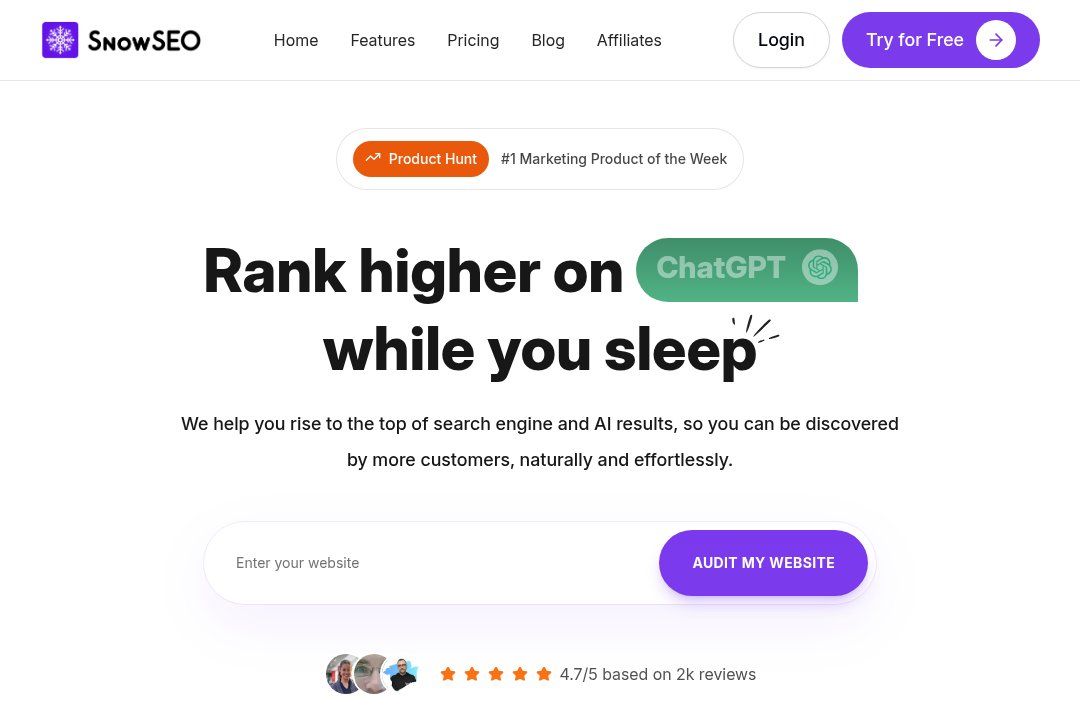
Ready to transform those fresh insights into measurable wins? Put today’s ideas into action with SnowSEO – the all-in-one platform built to automate every step of modern, AI-driven SEO. In minutes, SnowSEO uncovers high-intent keywords, generates human-sounding content tuned for both search engines and AI assistants, and tracks performance across Google, ChatGPT, and emerging discovery channels.
Here’s your momentum plan:
- Sign up for a free audit to see exactly where AI ranking gaps cost you traffic.
- Let SnowSEO’s keyword engine surface opportunities competitors overlook.
- Publish auto-optimized articles directly to your CMS with one click.
- Watch real-time dashboards reveal wins and trigger instant tweaks.
By threading data, content, and monitoring into a single workflow, SnowSEO solves the fragmentation that slows most teams. You focus on strategy – the platform handles the repetitive grind, from schema to sentiment analysis. Ready for next-level visibility and conversions? Explore our AI-Driven SEO tools to stay ahead and turn the 2025 tactics you just learned into sustainable growth.
Take the first step now – tomorrow’s page-one placement starts with the actions you commit to today.
Frequently Asked Questions
Q1: How is AI influencing SEO in 2025?
AI powers intent prediction, real-time SERP personalization, and automated content optimization. Instead of guessing, you feed models performance data and they rewrite titles, internal links, and schema to match shifting demand.
Q2: Do I still need traditional keyword research?
Yes, but the process flips. Language models surface semantic clusters first, then you confirm search volume and business value. That delivers fewer vanity terms and higher conversions per page.
Q3: What metrics matter most for AI-driven optimization?
User metrics beat raw traffic. Engagement depth, assisted revenue, and predicted satisfaction feed Google’s helpful content system and your algorithms. Track dwell variance across intents, not just average session time.
Q4: How can small teams leverage AI without big budgets?
Begin with freemium AI inside current tools: ChatGPT plug-ins for schema, Looker Studio dashboards, and GrammarlyGO tone checks. Pair them with tight testing sprints instead of buying huge platforms.
Q5: Will AI make human SEOs obsolete?
No. Algorithms spot patterns, but strategy, voice, and ethics stay human. Top teams couple creative editors with AI copilots, turning insight into scalable, search-friendly storytelling.
Conclusion
AI has moved from buzzword to backbone of modern SEO. Over the last few years, machine-learning algorithms have redefined how search engines interpret intent, evaluate content quality, and personalize results. For marketers, this shift is no longer optional; it is the new competitive baseline.
Key takeaways:
- Understanding AI’s role: Search systems now interpret semantics, entities, and user context in real time, rewarding brands that align content with these multidimensional signals.
- Practical applications: From automated content clustering to predictive link-building, AI tools accelerate analysis, surface hidden keyword opportunities, and free strategists to focus on narrative and authority.
- Preparing for future advancements: Generative engines, multimodal search, and privacy-centric ranking factors will continue evolving, so agility and continuous experimentation are essential.
Next steps:
- Audit your current tech stack and integrate at least one AI-powered insight platform to benchmark performance gains.
- Reserve time each quarter for advanced tutorials and live webinars that dissect algorithm updates and demonstrate hands-on workflows.
Stay inquisitive, test relentlessly, and let data-driven creativity guide your roadmap; those habits will keep your visibility-and your growth curve-compounding.